First attempts
The case for doing things badly before doing them well
You cannot edit the perfect version that never existed. A rough attempt gives the work something concrete to teach you.
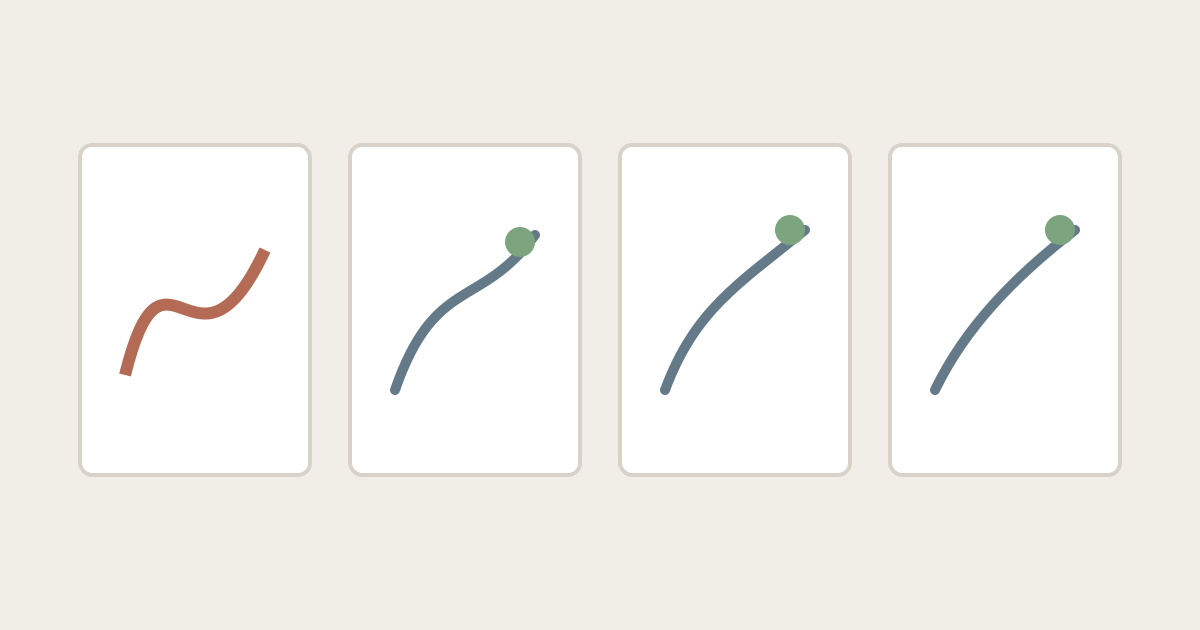
The first attempt has a different job
A first attempt is often judged against the standard of a finished result. That comparison is unfair because the two versions are doing different work.
The finished version has to communicate, function or perform. The first version has to reveal the problem. It shows where your understanding is thin, which part is harder than expected, what the materials do and what you need to learn next.
If it exposes those things, it may be a very useful first attempt even when it looks poor.
Perfectionism removes the feedback loop
Waiting until you know how to do something well creates a circular problem. You need experience to improve, but you are refusing the experience until you have improved.
The way out is not to lower every standard permanently. It is to move the standard to the correct stage.
Version zero can be clumsy. The public version may need care. The first practice session can be awkward. The eventual performance may need precision. Different stages earn different expectations.
A rough first version is not the opposite of quality. It is often the material quality gets made from.
Make the first version cheap
The more expensive an attempt feels, the harder it becomes to tolerate imperfection. A six-month plan, a large financial commitment or a public announcement makes every mistake feel consequential.
Where possible, shrink the first experiment. Draft one page instead of the whole site. Cook the dish for yourself before the dinner. Build the small prototype. Take the introductory class. Practise the difficult section before performing the whole piece.
A cheap attempt lets you buy information without demanding a polished outcome in return.
Name what the attempt taught you
Bad work only becomes useful when you look at it closely enough to learn something.
Instead of saying, “that was terrible,” be specific. The opening is too slow. My timing breaks here. I misunderstood the tool. The instructions were unclear. I need a smaller scope. This part worked better than expected.
Specific criticism points somewhere. A global verdict only makes the next attempt heavier.
Keep the embarrassing evidence
There is value in keeping some early work. Not for public display and not to romanticise being inexperienced, but because memory edits the past.
Months later, the original draft, recording, sketch or time can show improvement more accurately than your feelings can. What once looked like proof you were not good enough may become proof that practice changed something.
That comparison is especially useful when current progress feels slow.
Raise the standard after the work exists
Permission to make a rough first version is not permission to publish careless work. Once the material exists, a new job begins: revise, verify, practise, test or edit.
Quality grows through that second stage. The rough attempt made the problems visible; now the higher standard has something real to act on.
The mistake is not starting badly. The mistake is insisting that the starting standard and the finishing standard must be identical.
Practical artefact
Make a version zero
Create an intentionally incomplete first pass whose only job is to reveal what the second pass needs.
- Scope: Choose the smallest version that still exposes the real problem.
- Permission: Decide in advance what is allowed to be rough in version zero.
- Observe: Write three specific things the attempt taught you.
- Revise: Pick one improvement for version one instead of trying to fix everything at once.
Make something the next version can respond to
Starting badly can feel vulnerable because it replaces the imagined version of your ability with evidence. That evidence may be uncomfortable. It is also useful.
Once something exists, you can work with it. You can improve a rough draft, adjust a technique and learn from an attempt. The blank page offers none of those advantages.