Everyday objects
The drawer of things nobody knows whether to throw away
A key nobody can identify. Four batteries nobody trusts. A cable that might still belong to something. Three screws that feel too specific to discard. The drawer is full of tiny decisions nobody finished.
Keep this
The drawer is not full of junk. It is full of objects whose decisions have expired.
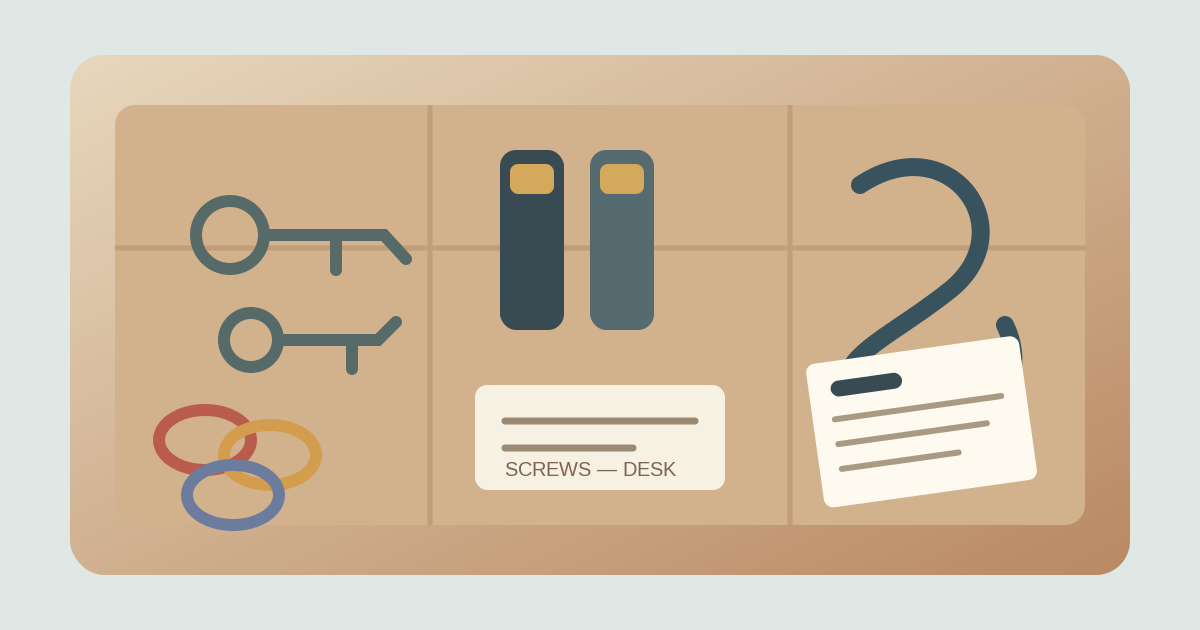
A drawer can be a queue of unfinished decisions
The strange thing about the miscellaneous drawer is that almost nothing in it began as rubbish. The spare key was important enough to keep. The cable once connected two things you owned. The tiny screws probably came from something that mattered. The batteries might still work. The instruction booklet felt useful at the time.
Each object arrived with a reason. What disappeared was the decision that was supposed to come later.
That is why reorganising the drawer can fail. A nicer tray sorts the objects by shape, but it does not answer the questions underneath them: What is this for? Does it still belong to something? Would replacing it be difficult? Is it safe to throw away? Who would know?
The drawer becomes a waiting room for decisions that are too small to interrupt a busy day and too uncertain to make quickly.
The object changes when you no longer know its job
A labelled spare key is a useful object. An unlabelled spare key is a puzzle with metal teeth.
A cable connected to a current device is equipment. A cable with an unfamiliar plug at one end and a vague sense of importance at the other is a future argument with yourself.
The same thing happens with screws, brackets, adapters and little pieces of hardware. Their physical value may be tiny. Their uncertainty makes them harder to discard because the cost of being wrong feels larger than the cost of letting them sit there.
That does not mean every mystery object deserves to stay. It means identification is a separate job from storage. If you cannot name the object, the first useful action is not to find it a better compartment. It is to decide whether anyone in the household can still explain what it belongs to.
The drawer is not full of junk. It is full of objects whose decisions have expired.
Some of the awkward things need a different exit
Electronics and batteries make the miscellaneous drawer more than a decluttering problem. They can need a specific disposal path.
The Australian Government’s e-stewardship guidance says Australia generated 511,000 tonnes of e-waste in 2019 — about 20 kilograms per household — and projects the total to grow by almost 30% by 2030. E-waste can contain valuable recoverable materials as well as hazardous materials, which is why it should not simply disappear into general rubbish.
Batteries are even more immediate. Government recycling guidance says old batteries should not go in household recycling or rubbish because they can produce sparks and start fires. Accredited and retailer collection schemes provide a safer path.
So the drawer needs at least one rule that is not about tidiness: objects with batteries, electronics or unknown electrical parts should be identified and sent through an appropriate recycling route rather than left indefinitely or dropped into the nearest bin.
Try this
Give every object one of five decisions
The useful unit is the decision, not the container. A half-empty drawer with five unresolved mysteries is less useful than a full drawer where every object has a known job.
“I might need it” is not one category
Some backups are sensible. A spare house key can save a night. The unusual screw from a piece of furniture may be impossible to match later. A charging cable for a device you still own is not clutter simply because it is not plugged in today.
But “might need it” becomes less convincing when the object has no identifiable owner, no known compatible device and no remembered use in several years.
A better question is: what future problem does this object solve?
If you can answer that in a sentence, label the answer. “Desk lamp spare adapter.” “Cot bolts — keep with manual.” “Front screen-door key.” A small label preserves the information that made the object worth keeping.
If nobody can answer, the uncertainty itself should not become permanent storage policy.
Time does not make a mystery object more useful
There is a quiet trap in keeping something “until we work it out”. The longer an object sits without context, the less likely anybody is to remember the context it once had.
A cable can survive three phone upgrades. A key can move houses. A bracket can outlive the flat-pack furniture it came with. At some point the household is no longer preserving a useful spare; it is preserving uncertainty.
This is where a deadline helps. Put unidentified objects in one small “work this out” section and date it. Ask the people who might know. Test the cable against devices you still own. Match the key to locks that still exist. If the answer never arrives and the object has a safe disposal path, let the deadline make the decision the drawer has been postponing.
The purpose of the deadline is not ruthless minimalism. It is to stop an object becoming harder to identify simply because nobody wants to be the person who throws out the mysterious important-looking thing.
Do not make the next person repeat the detective work
When a weird little object really does matter, record why.
Put the speciality screws in a small bag with the name of the furniture. Write the door or lock on the spare key tag. Keep the manual with the appliance model, not in a stack of unrelated paper. If a cable is a genuine backup, loop a label around it before every cable in the house becomes visually identical.
This sounds almost absurdly minor. That is exactly why it works. The drawer becomes difficult when dozens of tiny decisions are stripped of context.
Restoring a few words of context turns an object from “maybe important” back into something knowable.
The drawer earns its space when it reduces future confusion
A miscellaneous drawer does not need to disappear. Homes need somewhere for temporary things, small backups and objects between uses.
The problem starts when temporary uncertainty becomes permanent inventory.
You do not need matching dividers or a perfect system. You need a drawer in which the important things are identifiable, the unsafe things have a safe exit, and the mystery objects are not allowed to become heirlooms by accident.
The goal is not an empty drawer. It is a drawer where the next decision is easier than the last one.