Life transitions
The uncomfortable middle between who you were and who you are becoming
Change can be correct and still feel unfamiliar. The middle is where the old cues disappear before the new ones feel like yours.
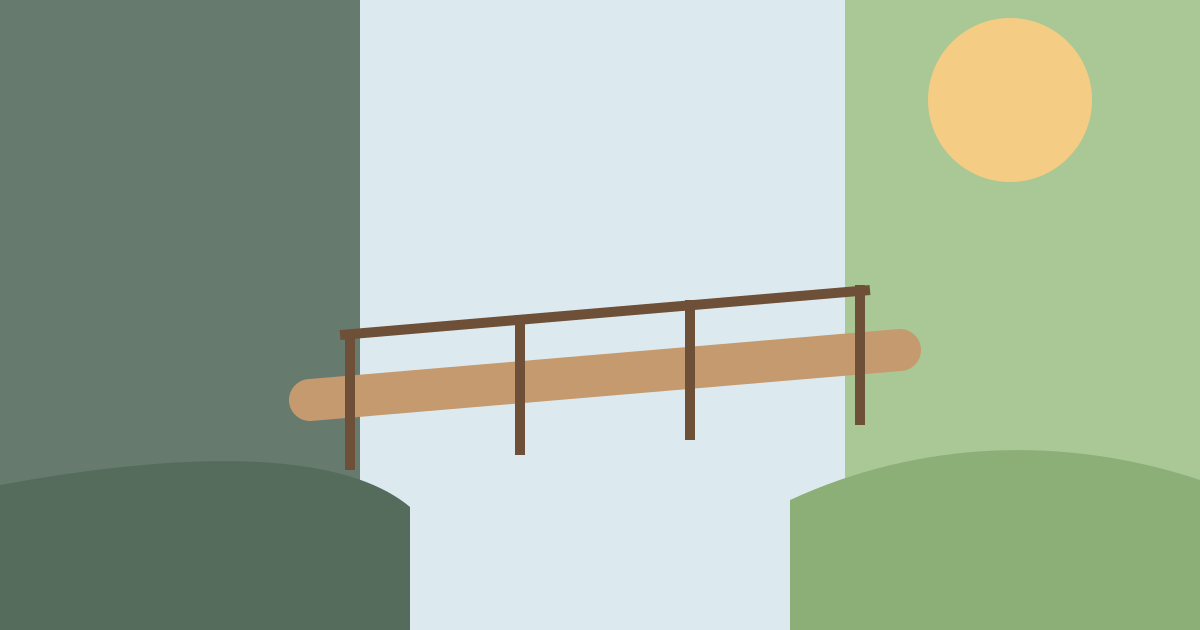
The old version can stop fitting before the new one feels natural
You can leave a job and still introduce yourself through the old one in your head. Move somewhere new and still organise your sense of home around the place you left. Change a habit and still expect the old impulse to decide the day.
Transitions create a lag between circumstance and identity. The facts may have changed before your internal picture has caught up.
That lag can feel like uncertainty about the decision itself, even when the decision still makes sense.
Familiarity can masquerade as correctness
The old way had instructions. You knew the route, the people, the shortcuts, the expectations and the version of yourself that operated there. Even when it was no longer right, it was legible.
The new situation may offer more possibility but less fluency. That can make the old life feel strangely convincing in retrospect.
Missing familiarity is not always the same as wanting the old life back. Sometimes you are missing the competence of knowing how everything worked.
The in-between feels unstable because it is unfinished, not necessarily because it is wrong.
Do not demand a finished identity too early
People often try to solve the in-between by choosing a label quickly: this is who I am now, this is what I do, this is the plan. A label can be useful, but it can also become another commitment made before enough experience has arrived.
Let behaviour lead for a while. Show up to the new work. Learn the streets. Practise the routine. Meet the people. Notice what fits.
Identity tends to become more convincing after repeated contact with reality.
Build anchors that belong to the present
A transition feels less disorienting when the present contains a few reliable anchors. They do not need to be profound.
A regular walk, a weekly call, a familiar breakfast, a desk arranged the way you like it, a recurring block of creative time: small repeated things tell the nervous system of daily life where to stand, without requiring you to have solved the entire chapter.
Choose anchors that support the current life rather than recreating the old one exactly.
Keep evidence of what is becoming true
Change is easy to underestimate while it is happening. The new routine may feel temporary for months, even as it quietly becomes normal.
Notice the firsts: the first time you solved the new problem without help, recognised someone at the local shop, handled the new responsibility without rehearsing it, or realised you had gone a whole morning without comparing everything to before.
These moments are not proof that the transition is complete. They are proof that the middle is moving.
Let some ambiguity survive
Not every uncertainty needs to be resolved before you can belong in the present. You can be committed to the next chapter without knowing how long it lasts. You can like the change and still miss what it replaced.
Two things can be true while the new shape settles.
The middle becomes easier to live in when you stop treating ambiguity as a problem that must be cleared immediately.
Practical artefact
The in-between map
Name what has ended, what is emerging and what can remain undecided for now.
- Ended: What part of the old chapter is genuinely over, even if you still miss it?
- Emerging: What new behaviour, relationship or responsibility is starting to feel more natural?
- Anchor: What repeated part of the present helps the new chapter feel real?
- Open: What question are you willing to leave unresolved for another month?
The middle is a place you move through
Eventually the new work becomes the work, the unfamiliar place becomes a route you know, and the behaviour that required effort becomes part of the day. You may not notice the exact moment.
Until then, you do not need to force certainty. Keep building enough present-tense evidence that the new life has somewhere to land.