Vision boards
How to make a vision board you will actually use
Most vision boards are finished the evening they are made. A useful one is still changing in June.
Keep this
Put the first ten minutes next to every wish. A board is finished when you start, not when the glue dries.
Why most boards stop working by February
The usual vision board is made in one good evening. There is a corkboard, a stack of magazines, a pair of scissors and a kitchen that will never be yours cut neatly from a property supplement. By ten o’clock it looks wonderful. It goes up behind the bedroom door, and by February it has become part of the door.
Nothing went wrong with the wanting. The trouble is that the board was complete the moment it was made. It shows where you would like to end up and says nothing about tomorrow, so there is no reason to look at it again.
A board that keeps working is built differently. It asks for less on the first evening and a little more every few weeks.
Start with a feeling, then get specific
Before choosing anything, decide how you would like the year to feel. Calmer, braver and closer lead to three different boards, even for the same person with the same job and the same flat.
The feeling works as a filter. A promotion might belong on a braver board and have no place on a calmer one. A picture you like but can’t connect to the feeling can be left in the magazine.
Two or three words are enough. One of them can sit in the middle of the board as the word for the year.
Make the wants small enough to picture
“Get fit” is hard to put on a board because nobody knows what it looks like. “Swim twenty comfortable lengths” is easy: there is a pool, a lane and a number.
Small wants are also easier to believe. A month of rent set aside is a real thing you could have by spring. Financial freedom is a mood. The smaller version still points in the same direction, and you can tell when it has happened.
Spread them around. A board that is entirely about work stalls the first time work has a bad month. Aim for a few parts of life: body, money, home, people, work, play, learning and rest. Eight wants is plenty for one board.
Put the first ten minutes next to every wish. A board is finished when you start, not when the glue dries.
Give every want a first ten minutes
This is the step most boards skip, and it is the one that matters. Next to each want, write the first thing you could do about it in ten minutes, today, without buying anything.
For the swimming, it might be checking the pool’s opening hours. For the rent, renaming a savings account. For dinner with a parent once a month, texting two dates. None of these is impressive. Each one turns a picture into something that has started.
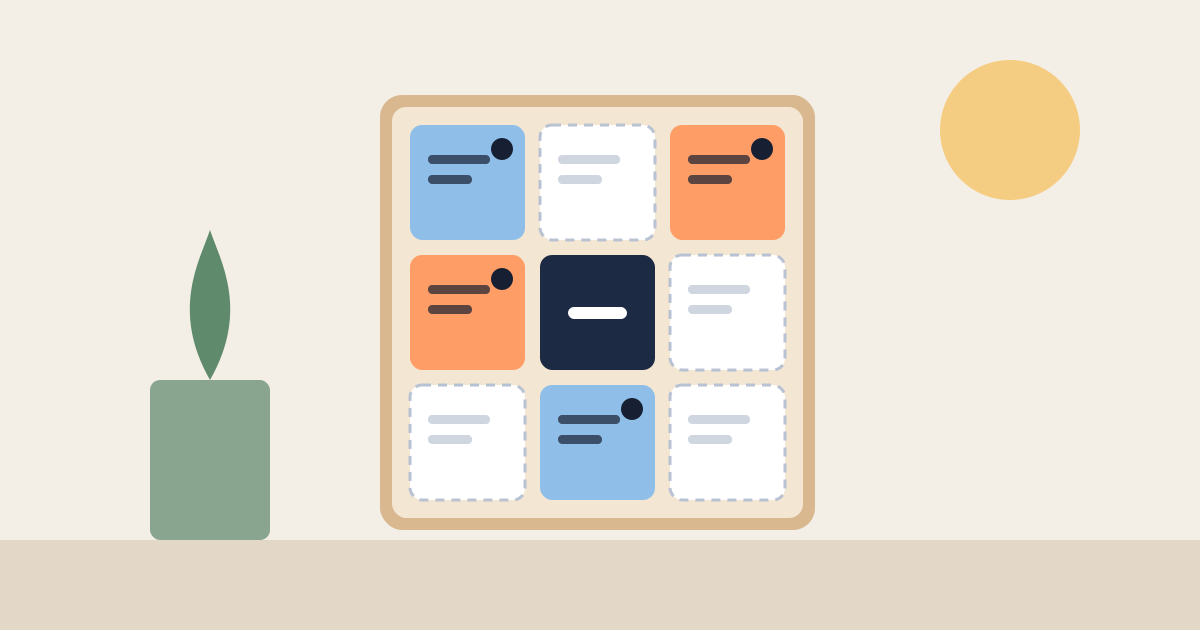
When a step is done, mark it. Colour the tile in, tick the corner or move it to the top row. Then write the next ten minutes underneath. The board now shows what is under way and what is still waiting.
Put it where you will see it by accident
A board works by being seen on days when you were not planning to think about your life. Behind a door is a poor spot. A phone lock screen is a good one, because it is looked at dozens of times a day. So is the fridge, or the wall above the kettle.
If the board lives on your phone, save a new copy whenever something changes. A lock screen that slowly fills with colour is more persuasive than one that never moves.
Come back once a month
Pick a regular moment, such as the first Sunday of the month, and spend ten minutes with the board. Colour in whatever moved. Rewrite any first step that turned out to be the wrong one. Take off a want that no longer sounds like you and put something else in its place.
Changing the board is part of using it. By December it should look different from the one you made in January, with most of the pencil gone and at least one tile you would not have predicted.
Try this
The one-tile test
Try a single tile before you make a whole board. If these four lines are easy to fill in, the want is ready.
- The want: One small thing, written the way you would say it out loud.
- The feeling: Which of your words for the year it belongs to.
- The first ten minutes: Something you could do today without buying anything.
- Where you will see it: The lock screen, the fridge or the wall above the kettle.
A board is a record you add to
The evening with the scissors is the pleasant part, and there is no harm in enjoying it. What makes the board useful is everything after: the small steps beside each want, the tiles that change and the ten minutes a month.
If you would rather skip the glue, the Moving Board is a free vision board maker built this way. It starts from a feeling, gives each want a first ten minutes and colours a tile in when the step is done.